Recruit mercenaries from across the galaxy and fight for four Arenas.
Strength wins rounds — but the weaker your winner, the more it scores.
First to 40 points takes it.
4 Arenas
Discipline, Brains, Strength and Agility. Each card carries a number for all four,
and only the active Arena's number counts. The Arena rotates every round.
3 Nics
Water douses Fire, Fire burns Earth, Earth stops Water. Your mercenary can never
share the Nic of the one it's trying to beat — so a lead can lock a colour out.
40 to win
You score the PV of every mercenary you win with. Hold all four
Arenas and your defenders count double.
Play the odds
The CPU counts every card it hasn't seen and plays the percentages. When that
stops being enough, switch it to Advanced on the game board: that
one also reads what you reveal — the Nics you couldn't answer, the cards
you publicly forfeit — and plays the player.
Never seen this before?
The rules are short, and the game teaches itself once you've watched a round.
Watch one first
A full worked round, straight from the printed rulebook — including the twist
where a Reset kills a modifier mid-fight.
CPU
no protection
0POINTS
ACTIVE ARENA
DISCIPLINE
—
Round 1
band 99-75 · deck 0
CPU
BATTLE LOG▾
YOU
no protection
0POINTS
How to Play
Two players hire mercenaries and fight for four Arenas. Every round is a bidding war
of one-upmanship: each side answers the other until someone can't — or won't — top it.
The cards
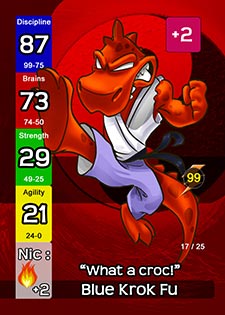
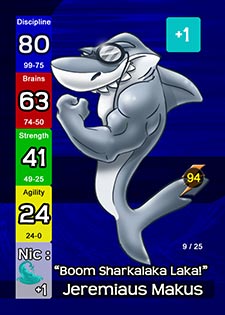
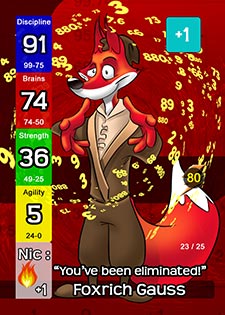
Every mercenary carries four attribute numbers, one per Arena, in fixed non-overlapping bands:
DISCIPLINE 99–75
BRAINS 74–50
STRENGTH 49–25
AGILITY 24–0
Only the active Arena's number counts — that's the card's Arena Value.
A card that rules Discipline may be worthless in Agility.
Each mercenary also has a Nic — its Naturally Inherent Characteristic,
which works like a suit:
WATER douses Fire
FIRE burns Earth
EARTH stops Water
PV is your score. The +1 to +5 badge in the top-right
corner is the Protection Value, and it's the only number that earns points. It measures how
far a card sits from the top of its bands — so weak cards are worth more. Winning a
round with a +5 is a coup; winning with a +1 barely moves the needle. That tension is the game.
The lightning number is decoration here. It's the card's Power Rating, and it
only ever mattered for building custom mercenaries — it never affects who wins a round. It's on
the cards, so it's on screen, but the game never reads it.
A round, start to finish
The Lead Player opens with a Combo: one mercenary, optionally
plus one Action or Modifier card.
The Follower answers with a Combo. Their mercenary cannot share the Lead's Nic.
This is the only time you're allowed to play a losing Combo.
Highest Arena Value leads. On a tie, the dominant Nic wins.
Play alternates. On your turn you must play a Combo that beats the current
winner — never matching its Nic — or Submit.
If it's your turn and you're already winning, you take the round.
Beaten mercenaries are discarded immediately, along with any Modifier attached to them.
Action cards stay live for the whole round.
Winning a round
Your winning mercenary either Defends the Arena you won it in — one mercenary per
Arena per game — or Runs Protection beside your Arena card. Either way you score
its PV. Defending is the ambitious line: hold all four Arenas and every defender
scores double.
Then the Arena rotates Discipline →
Brains → Strength →
Agility → back around, the round winner becomes the new Lead,
and both players draw back up to a full hand — six by the book, though the HAND control
on the game board lets you house-rule anywhere from 5 to 10. First to 40 points wins.
Modifier cards (M1–M3)
Each Power card governs one matchup. Paired with the natural winner of that pair it's a
straight bonus; paired with the natural loser it's a smaller bonus plus an outright
reversal of that matchup. Pairing it with the third Nic isn't a legal play.
Card
Played with
Effect
M1
Water
+5 Arena Value
M1
Fire
+3, and Fire now beats Water
M2
Fire
+5 Arena Value
M2
Earth
+3, and Earth now beats Fire
M3
Earth
+5 Arena Value
M3
Water
+3, and Water now beats Earth
A Modifier is only alive for the mercenary it was played with, in the Arena it was played in.
Change the Arena and it dies on the spot — which is exactly what Reset is for.
Action cards (A1–A4)
Card
What it does
A1 Switch
Your mercenary is discarded and you seize the combo that's currently winning.
If you go on to take the round, that stolen mercenary is what defends and what scores.
A2 Go Low
The round inverts: lowest Arena Value wins, and every Nic matchup
currently in force flips. Bonuses still add — which now works against you.
A3 Force
Played alone. The winning combo is discarded outright; its owner replays a bare
mercenary, then you answer with one too. No support cards on either side — and
your answer still can't match their Nic.
A4 Reset
Name a different Arena — it decides this round, and the next round follows
on from it. Any Modifier stranded in the old Arena dies.
Go Low and a Modifier at once? The reversals stack, and the order they were
played decides the outcome. A Modifier sets its matchup; Go Low inverts everything
currently in force. Play M3-Water first and Water beats both Earth and Fire — then Go Low
flips both and Water beats nothing. Play Go Low first and the Modifier merely restates
what's already true (and its bonus now hurts you). A Nic can end up beating both others, or
neither — but never tying.
When you can't play
Mid-round, Submit is always yours to take — you may concede even holding a
legal play, which is sometimes right if winning would cost more than the round is worth.
The opening exchange is different: the Lead must lead, and the Follower must answer if they
possibly can. Only if you can't open — no mercenary in hand, or the Nic restriction
locks out your whole hand — do you submit, and it costs you: publicly discard one to
three cards. You choose which cards and how many, and the discard is
public, so your opponent sees exactly what went. Your hand refills to full size at the end
of the round, so shedding three dead cards is a genuine decision, not just a punishment.
Notes on this version
This is the game exactly as it shipped: 45 mercenaries, three Power cards, four Action cards.
Custom card creation and the exclusive-mercenary modifiers that went with it are documented
but deliberately not implemented here.
Two small calls the printed rules leave open, resolved so the engine can be consistent:
the Nic restriction applies to Switch just as it does to any other answer, and when Force
destroys your combo, you choose which bare mercenary replaces it —
the CPU picks its own replacement itself.
A worked round
This is the sample round from the printed rulebook, played in the
Discipline Arena — so every Arena Value below is the
card's blue number. It shows why the strongest card doesn't simply win.
STEP 1 — THE LEAD
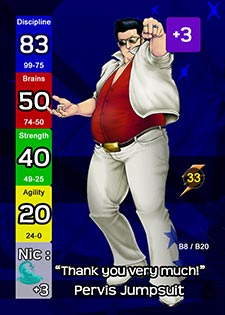
Pervis Jumpsuit opens at 83
A deliberately feeble lead. It isn't about the 83 — it's Water, and that locks the
Follower out of answering with any Water card at all. Leading weak also means that if
it somehow survives, it scores a fat +3.
STEP 2 — THE ANSWER
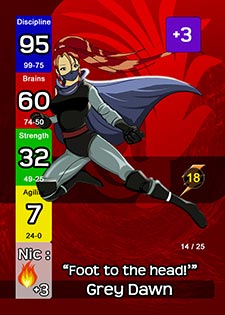
Grey Dawn takes the lead at 95
Fire, so the Nic restriction is satisfied, and 95 comfortably clears 83. Pervis Jumpsuit
is discarded. Grey Dawn is now leading — and if the Lead can't answer, it wins the round
and banks its +3.
M1
Power
Water / Fire
Played with Water: +5 Arena Value.
Only alive in the Arena it was played in.
STEP 3 — THE POWER PLAY
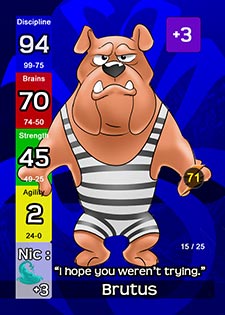
Brutus answers with a Power card: 94 becomes 99
Water beats Fire, and Brutus is spending an M-card for +5 to clear Grey Dawn's 95.
That's a strong position — but the Modifier is only alive in this Arena, and
that's the crack the Follower is about to lever open.
A4
Reset
Name a different Arena — it decides this round,
and the next round follows on from it. Modifiers stranded in the old Arena die.
STEP 4 — THE TWIST
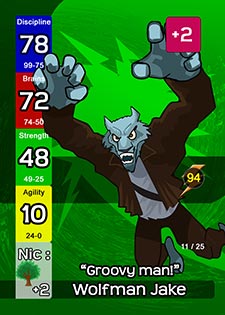
Wolfman Jake + Reset → the Strength Arena
Reset moves the fight to Strength, and the whole board re-reads itself. Brutus's +5
Modifier was played in Discipline, so it dies instantly. What matters now is the green
number: Wolfman Jake's 48 against Brutus's 45.
Jake leads — and he's Earth, which the Water Brutus can't answer.
STEP 5 — THE ROUND
The Lead submits. Wolfman Jake wins — in Strength
Here's the sting in the tail: the round was won in the Strength Arena,
not the Discipline Arena it started in. So Jake can only defend Strength, and the
next round follows on from Strength too. One Action card redirected the entire game.
The lesson: raw Arena Value is only ever the surface. Nic locks out answers,
Modifiers are hostages to the Arena they were played in, and a single Action card can move
the goalposts after everyone has committed.
The Deck — 45 mercenaries
Cards 1–25 are the main set; B1–B20 were designed by the original Kickstarter backers.
No attribute number is repeated anywhere in the main set — every value in every band appears
exactly once, which is what makes counting cards worthwhile.
The Printed Rulebook
Scans of the 16-page booklet that shipped in the tin, plus the cover, the back and the
card flats. This is the original article — the rules pages in this site were transcribed
from exactly these images.
Click any page to see it full size. Every page has its own download, or take
the lot in one go.
Make a Card
Build your own mercenary from a picture on your computer.
The rating is worked out by the original 2013 formula, so your card is balanced on the
same scale as the printed 45.
Your picture never leaves this browser. It is read from your machine,
framed here, and baked straight into the card — nothing is uploaded, and nothing is stored
on any server. Cards are kept in this browser only, and you can wipe them at any time.
Saving is off. To keep cards between visits, the game needs to use this
browser's local storage — a small amount of space on your own machine. Nothing is sent
anywhere, and "Delete everything" removes it all.
50RATING
+5PROTECTION
Choose a picture, then drag it in the frame to position it.
A thin mount of the Nic background around your
picture, so blue, red or green still reads at a glance. Switch it off and the picture
runs edge to edge across the whole card.
Nic
Discipline
Brains
Strength
Agility
Your cards
Saved here only. Before each new game you'll be asked whether to shuffle
them in — say yes and either player can draw them, exactly like a printed mercenary.